Playing on the Roof of the World: Mexico's Three Venues and What They'll Ask of Players
Three Mexican stadiums all rank in the top four for player difficulty across the entire tournament. Here's what makes each of them so demanding.
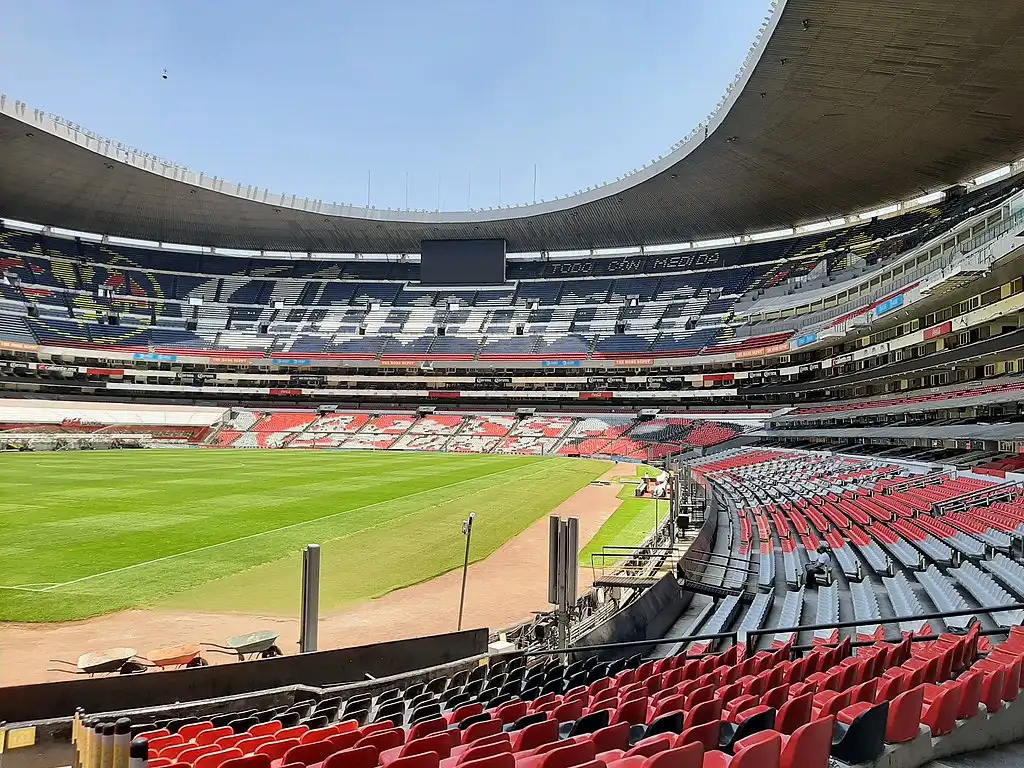
Image credit: Luicheto / CC BY-SA 4.0
This summer's World Cup spans three countries, and plenty of the US venues present their own challenges in the summer heat. But Mexico is different. In our upcoming climate difficulty assessment across all sixteen host venues, all three Mexican stadiums rank in the top four for the physical toll they will take on players — with only Miami keeping them company. For any team with fixtures south of the border, the environment is not background noise. It is part of the opposition.
Estadio Azteca, Mexico City — Where the Air Runs Out
The famous Azteca (pictured above) is one of if not the most storied stadium in world football. Part of it's allure is it's infamy for being unforgiving. Sitting at 2,240 metres above sea level, atmospheric oxygen pressure is roughly 25% lower than at sea level. What that means in practice is faster fatigue, higher heart rates at every level of exertion, and a dramatically reduced capacity to sustain the high-intensity output — pressing, sprinting, rapid changes of pace — that defines the modern game.
None of that changes after sunset. Mexico City's mild June temperatures, typically 16 to 21°C and dropping into the low teens by evening, might make the Azteca sound pleasant on paper. Physiologically, it is anything but.
Mexican football commissioner Mikel Arriola was not shy about it. "We have a massive advantage as the host country because we're playing at the Estadio Azteca with our fans and the altitude. It is a very potent setting." He is right, and every visiting nation knows it.
Historical evidence is stark. At the 1970 World Cup, Czechoslovakia lost all three group games, and their failure to prepare for the altitude was widely cited as a contributing factor. Brazil, the eventual winners, arrived in Mexico City 32 days before their opening match in one of the most meticulous acclimatisation programmes in World Cup history. Players still reported bloody noses and throat dryness on arrival from the rarefied air. Even 32 days was not quite enough to make it easy.
England, preparing for that same tournament, played high-altitude matches in Colombia and Ecuador to ready themselves. The trip was not without incident — captain Bobby Moore was arrested in Bogota on a fabricated shoplifting charge, held for several days and released only under significant diplomatic pressure. He rejoined the squad, led them through the altitude preparation and played in one of the great World Cup matches, the 1-0 group stage defeat to Brazil. Moore's verdict on the preparation camp was characteristically understated: "I was better off in jail."
For 2026, nations are approaching the Mexico City problem in very different ways. South Africa have based themselves in Pachuca at over 2,400 metres, higher than the Azteca itself. South Korea spent several weeks in Salt Lake City at 1,300 metres, with coach Hong Myung-bo acknowledging: "We've had very little exposure to this environment, so I've consulted with experts to determine our needs." Colombia, who play 2 of their 3 group K games in Mexico, train at home in Bogota at 2,600 metres, carry a natural advantage that most rivals would pay dearly for.

As an Amazon Associate, MyTourneyTime earns from qualifying purchases.
Estadio BBVA, Monterrey — The Oven That Doesn't Cool Down

Image credit: J4im31000 / CC0 1.0
Monterrey swaps altitude for a different kind of punishment entirely. The Estadio BBVA is an open-air metallic structure that traps heat with remarkable efficiency. The steel roof reflects heat directly onto the pitch while blocking any natural breeze, and the city sits in a bowl geography that prevents warm air from dispersing.
The earliest local kickoff at this venue is 19:00, so teams will avoid the worst of the direct afternoon sun. It will not make as much difference as you might hope. Temperatures in Monterrey regularly linger above 30°C after dark, and relative humidity rises significantly in the evenings. When humidity is high, sweat cannot evaporate effectively and the body's primary cooling mechanism is compromised. Players simply cannot shed heat fast enough. It is the kind of venue where second-half drop-offs are predictable, squad depth matters enormously and the team that rotates wisely will outlast the one that does not.
Estadio Akron, Guadalajara — The Hybrid
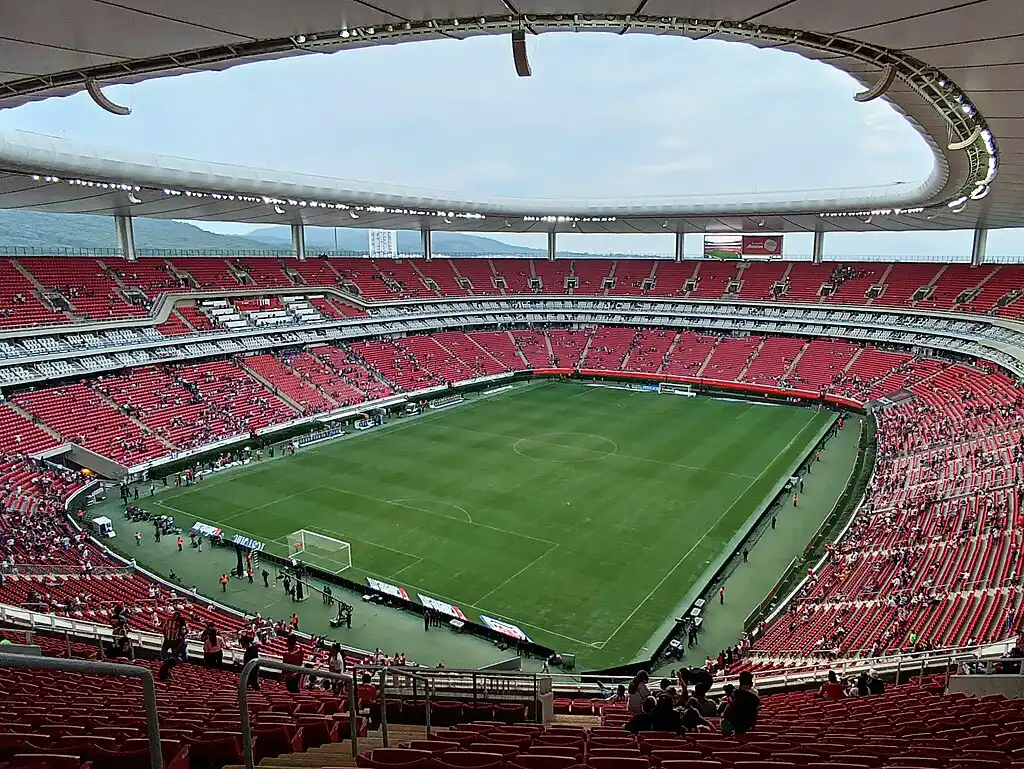
Image credit: Alejan98 / CC0 1.0
Guadalajara is the most manageable of Mexico's three venues, which is not the same thing as straightforward. At 1,566 metres, altitude is a genuine factor for unacclimatised sides, even if it falls well short of the lung-burning severity of Mexico City.
All four fixtures at the Akron kick off between 18:00 and 20:00 local time, which brings its own variable into play. June in Guadalajara is the start of the tropical wet season, and evening kickoffs regularly coincide with heavy thunderstorms. A saturated pitch increases muscular fatigue in changes of direction, and the thick, humid air that accompanies the storms impairs the body's ability to regulate temperature even when the thermometer reads a relatively mild 23 to 26°C. It will not look gruelling on paper. After sixty minutes in those conditions, it will feel it.
We will be publishing our full climate demands feature shortly, rating every host venue and mapping out how the draw affects each nation's physical journey through the tournament. The route a team takes matters enormously at this World Cup, and nowhere illustrates that better than a simple example: if England top their group as expected and Mexico top theirs, and both navigate their round of 32 fixtures against third-place teams, they meet in the round of 16 — in Mexico City, at the Azteca, at altitude. Mexico would be favourites in most people's books for that fixture in those conditions. It is difficult to think of a previous tournament where the route through the draw has carried quite this much weight.
Try The Tools
PREDICTOR - Predict the tournament and see those routes ⚽
Explore MyTourneyTime's World Cup tools, routes, fixtures and tournament views in one place.
Read Next
Feature: Climate Knockout Crisis World Cup ’26
Major advantages lie ahead for those on the right route. Use our climate chart to see which teams benefit.