FIFA's 2026 World Cup: The Greatest Fleecing on Earth
From banning water bottles in summer heat to outrageously priced tickets, FIFA's 2026 World Cup has become a masterclass in extracting money from the people who love football most. Fans are noticing.
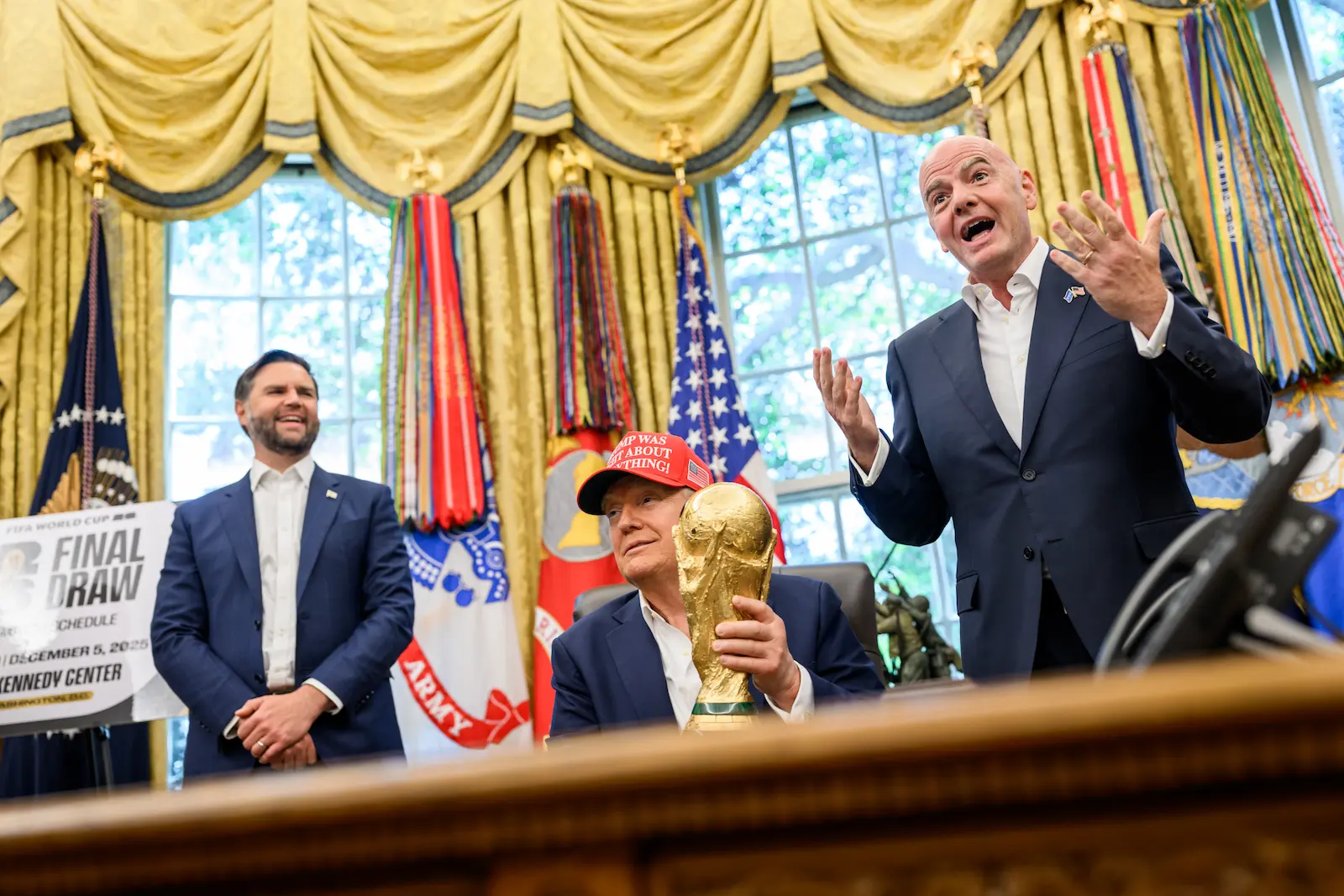
Image credit: The White House (Licence 1.0)
It was the water bottle that did it.
Not the ticket prices. Not the travel costs. Not the hotels. After months of quietly absorbing everything that FIFA has thrown at the ordinary football fan in the build-up to this summer's World Cup, it was the announcement that supporters would no longer be permitted to bring a reusable water bottle into a stadium — in the middle of an American summer, at venues where temperatures are expected to comfortably, or more so uncomfortably hit 28°C+. It feels like the straw that broke the in this case non-water carrying camel’s back.
FIFA had previously said empty transparent bottles would be allowed so fans could refill them. Then, days before the tournament, they changed their minds. The official reason was safety. Bottles, apparently, present a risk of injury if thrown. For an organisation that has placed matches in open-air venues in temperatures that medical professionals have described as dangerous for sustained physical activity, the sudden concern for fan welfare lands with all the sincerity of a US citizen receiving a get-well card from their medical insurer.
Shouldn’t say it out loud in case FIFA hear, but has anyone considered dynamic pricing on water? The warmer the weather, the higher the price. Dystopian unfortunately seems to be in keeping with the current FIFA regime.
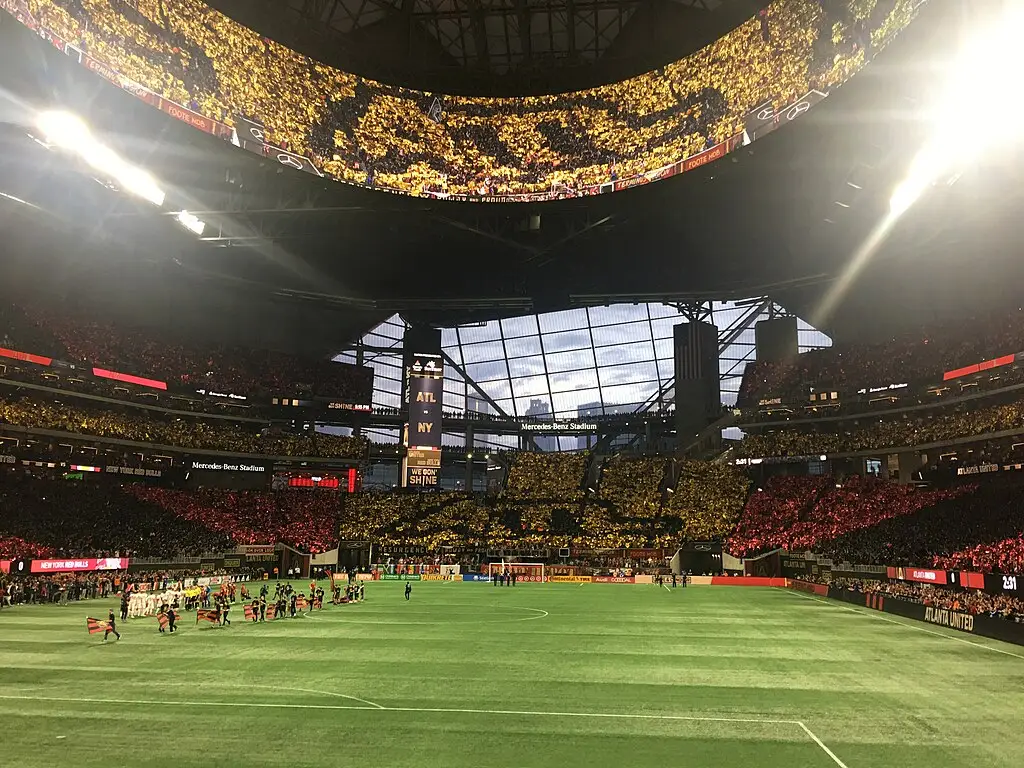
Image credit: Eric.Jason.Cross / CC BY-SA 4.0
What made the water bottle announcement worse was the immediate response from Mercedes-Benz Stadium (pictured above), who posted on X that fans should remember they can get a fountain Coca-Cola with unlimited free refills for just two dollars! That was intended as reassurance by the way, a positive in the eyes of the Atlanta stadiums marketing team; FIFA have likely alerted their recruitment team to make enquiries.
Talking of dystopian it all reads more like a scene from the Indie Mike Judge film Idiocracy. In the film he used Mountain Dew to show how pitiful the state of affairs had got, in this case it’s fittingly the poster boy drink of capitalism, one of the many tournament official sponsors Coca-Cola, is offered as a sugary solution to a hydration crisis.
We have got the mandatory three-minute “hydration breaks” in the middle of each half for player welfare though, even at the stadiums that have climate control and when they’re playing at night. The USA 94 tournament pushed for soccer to be played in quarters to get in extra ad breaks, they’ve managed to manufacture it this time. Whilst the players take on water and the advertisers get their revenue, the fans get told to buy a Coke.
The Ticket That Time Forgot
A ticket to the 1966 World Cup final at Wembley, adjusted for inflation, would cost you around fifteen dollars today. The cheapest general sale Category 3 ticket for the 2026 final starts at $1,490. That is not a typo. That is one hundred times the price.
FIFA initially announced category 1, 2 and 3 tickets for the tournament. Following public disgust of the pricing they were pressured into creating a category 4, starting at $60 a ticket; which obviously had a minimal allocation in the far reaches of the upper tiers. Conceding on price for around 1% of the seats likely irked the FIFA upper echelons, so in April they came up with the “Front” category tickets, in effect an enhanced category 1 and 2 +. For the USA’s opening game against Paraguay that saw the “Front” category 1 tickets jump from $2,735 to $4,105! It’s laughable that anyone would even think this is a good idea, the category 1 tickets were already in the lower tiers closest to the pitch, anyone who has actually been to a football game knows that after the age of 7 the front rows with their poor vantage point are not the place you want to be. I assume at the prices that some buyers are expecting Carlo Ancelotti to pop over for a mid-game chat; maybe that’s what the water breaks are for? Whilst laughable it should cause concern for football fans around the world that an official body is deeming this legitimate behaviour.
This week the pricing story got murkier. FIFA stands accused of offloading tickets for lower-demand matches through unofficial resale platforms, including SeatGeek, rather than reducing prices on their own website. The alleged motivation was straightforward. If they lowered prices officially, fans who had already paid full price could demand refunds. By routing tickets through third-party channels, they avoided that inconvenience. The evidence cited was simple: entire rows and sections appearing simultaneously on SeatGeek, which does not happen in normal fan-to-fan resale. Both SeatGeek and StubHub denied having any agreement with FIFA. It’s unclear if wrong-doing will be proved, New York and New Jersey department of consumer and wokrker protection (DCWP) have opened investigations.
Getting There Will Cost You Too
New York and New Jersey DCWP may be taking up the fight on ticket selling practices, but it’s New Jersey Transit who have been the focus of exorbitant rail fares to get to the MetLife stadium. A return trip from New York where fans will be based is usually $12.90, for matchdays it was initially set at $150! Following a torrent of negative coverage the price is now down to a still intolerable $98, New Jersey Governor Mikie Sherrill has been at the centre of this, seemingly happy with his corporate saviours, tweeting:
"Good news: Ahead of NJ Transit World Cup train tickets going on sale, NJ Transit is lowering ticket prices to $98 without New Jersey taxpayer money, Thank you to our partners for helping make this possible."
To be fair to Sherrill he’s become embroiled in an argument with FIFA about who’s at fault. Tweeting his annoyance that he, “Inherited an agreement where Fifa is providing $0 for transportation to the World Cup," his anger seems to be at the money making circus rolling into town, “While NJ TRANSIT is stuck with a $48m bill to safely get fans to and from games, Fifa is making $11bn.” FIFA in turn pointed at a 2018 agreement that required host cities to provide free transportation to matches. It all seems a bit of a stalemate between FIFA and the governor, so of course it will fall on the fans to pay.
In Europe it’s common for host cities of club European finals and even group games to offer free transport to their visiting guests, it keeps the network flowing rather than huge number of essentially tourists prodding at unfamiliar ticket machines and it’s a nice touch, a little thank you for spending decent sums in the host city. Indeed, the last 2 world cups Qatar and Russia both had free travel throughout the tournament. It’s mad when you think the last 2 locations were Qatar and Russia and yet it feels that FIFA gave this World Cup to the USA to be more unscrupulous than ever.
And then there are the things that go beyond money. Iran are currently training in Mexico because they cannot gain entry to the United States. Real concerns exist about whether fans from certain nations will be able to attend, and what treatment they might face from immigration authorities if they do. And then there is Ebola, a story that has drifted beneath the radar of most tournament coverage but which represents perhaps the most serious cloud hanging over this summer.
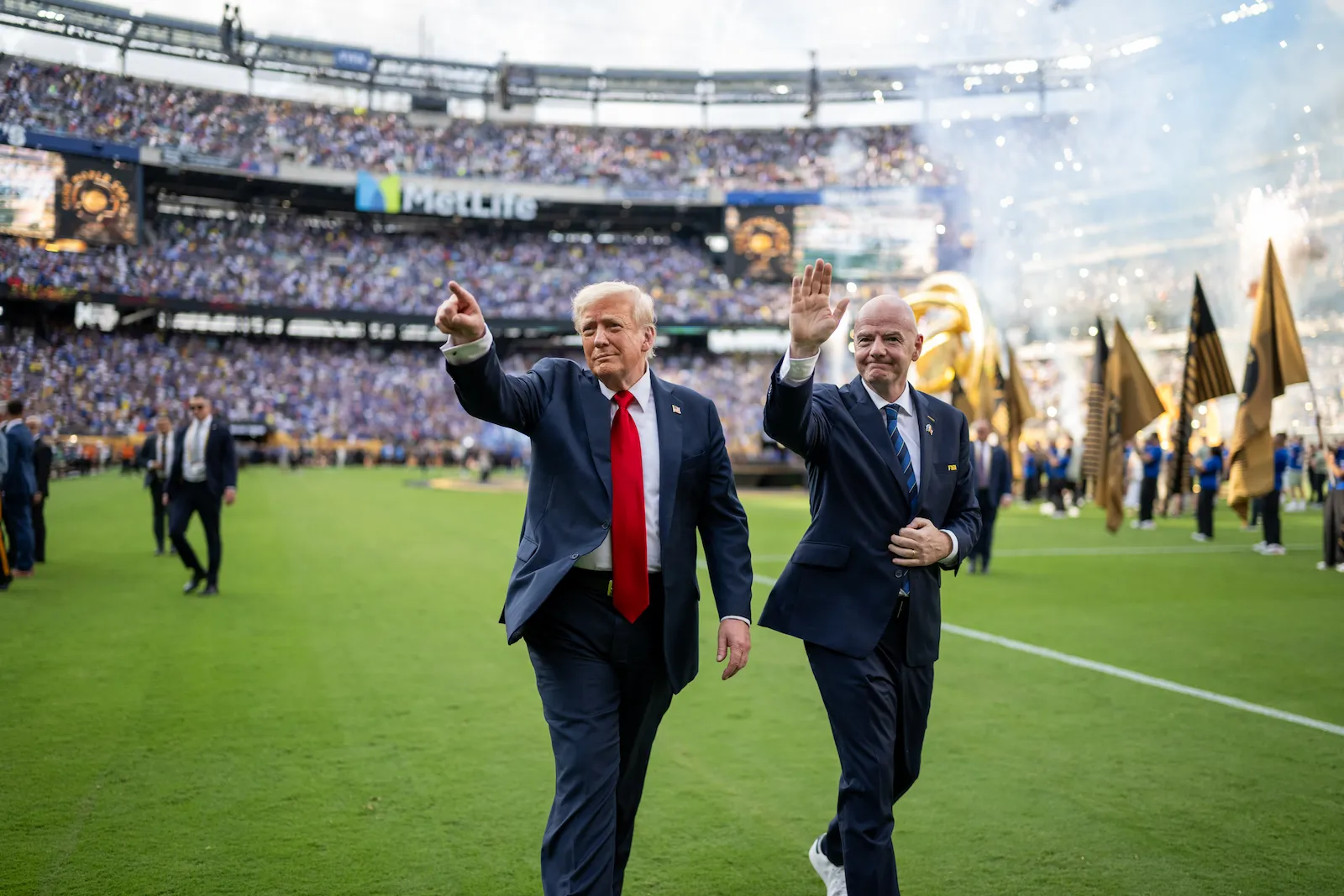
Image credit: The White House (Licence 1.0)
(FYI - The irony of me moaning about fans being fleeced by big corporations whilst my amazon associate ad for a world cup ball pops up is not lost on me!)
As an Amazon Associate, MyTourneyTime earns from qualifying purchases.
From Blatter to Infantino
Some of us are old enough to have read books about legendary FIFA snout in the trough specialists Sepp Blatter and Jack Warner. About brown envelopes and vote-buying and the systematic plundering of a sport that billions of people love. It felt, at the time, like something that would eventually be exposed, dealt with and consigned to history. The game would be cleaned up.
It was not cleaned up. It got comfortable.
Gianni Infantino walked into the White House and stood next to Donald Trump, who received FIFA's inaugural Extraordinary Football Award, a shiny new peace prize conjured specifically for the occasion. Trump, a man who has displayed approximately zero interest in football across eight decades on this earth, received the accolade with the expression of someone who had just been told he was the smartest person in the room and had no reason to question it. FIFA got their political runway cleared. Trump got his shiny accolade telling him how great he was. Not once, apparently, did the conversation turn to what everyday citizens attending this tournament were being asked to pay.
Everybody Has a Limit
There has long been a feeling among football fans that their game has been hijacked by capitalists and corporate greed has become the norm. In England fan groups like The Spirit of Shankly (SOS) who represent Liverpool have started working with the football supporters association (FSA) to organise fan groups across tribal divisions to work together on issues that affect them as a collective. However, fans travelling to a World Cup from forty-eight different nations, speaking different languages, navigating different visa regimes, have no equivalent mechanism. FIFA know this.
What this summer has produced is the free market World Cup in its purest form. Not just expensive, we have come to expect expensive, but brazen. Unapologetic. A tournament that has decided the love of football is an inexhaustible resource that can be taxed indefinitely without consequence.
Except the consequences are beginning to show. Several stadiums remain less than sold out. The tourists did not all materialise. The corporate hospitality packages did not all shift. When you price out the actual football fans and replace them with a hoped-for wave of wealthy neutral consumers, those consumers turn out to have other options. Football is the biggest show on earth, but everybody has a limit and FIFA have been uncomfortably at ease about testing where that limit sits.
Club owners around the world should take note, and behind closed doors should be fuming with FIFA. In domestic leagues fans were already becoming dismayed with the general price of football, the excessive release of kits, late announcements of kick off changes to suit broadcasters. This World Cup has shown the cold light of day, what the money men will do given the chance and should serve as a warning, not that it was needed, for fans around the world.
The current FIFA regime would likely consider sticking a card reader on a fire exit, and probably tout it to AMEX or Mastercard to be the official sponsor. Maybe it needs the European federations to find some courage and stand up to them, but are they really any better? From Blatter to Infantino, surely this hyper-capitalisation of football has to come to an end.
The SOS group mentioned above campaign with the slogan, “Enough is Enough”. Well, this World Cup has shown the organisers still want more.
Try The Tools
Explore the 2026 Tournament ⚽
Explore MyTourneyTime's World Cup tools, routes, fixtures and tournament views in one place.
Read Next
104 Games. But What Will They Be Worth?
The 2026 World Cup is the biggest in history. More teams, more games, more nations involved. But with weaker groups and two-thirds of third-placed teams qualifying, are we sleepwalking into a group stage that nobody cares about?