104 Games. But What Will They Be Worth?
The 2026 World Cup is the biggest in history. More teams, more games, more nations involved. But with weaker groups and two-thirds of third-placed teams qualifying, are we sleepwalking into a group stage that nobody cares about?
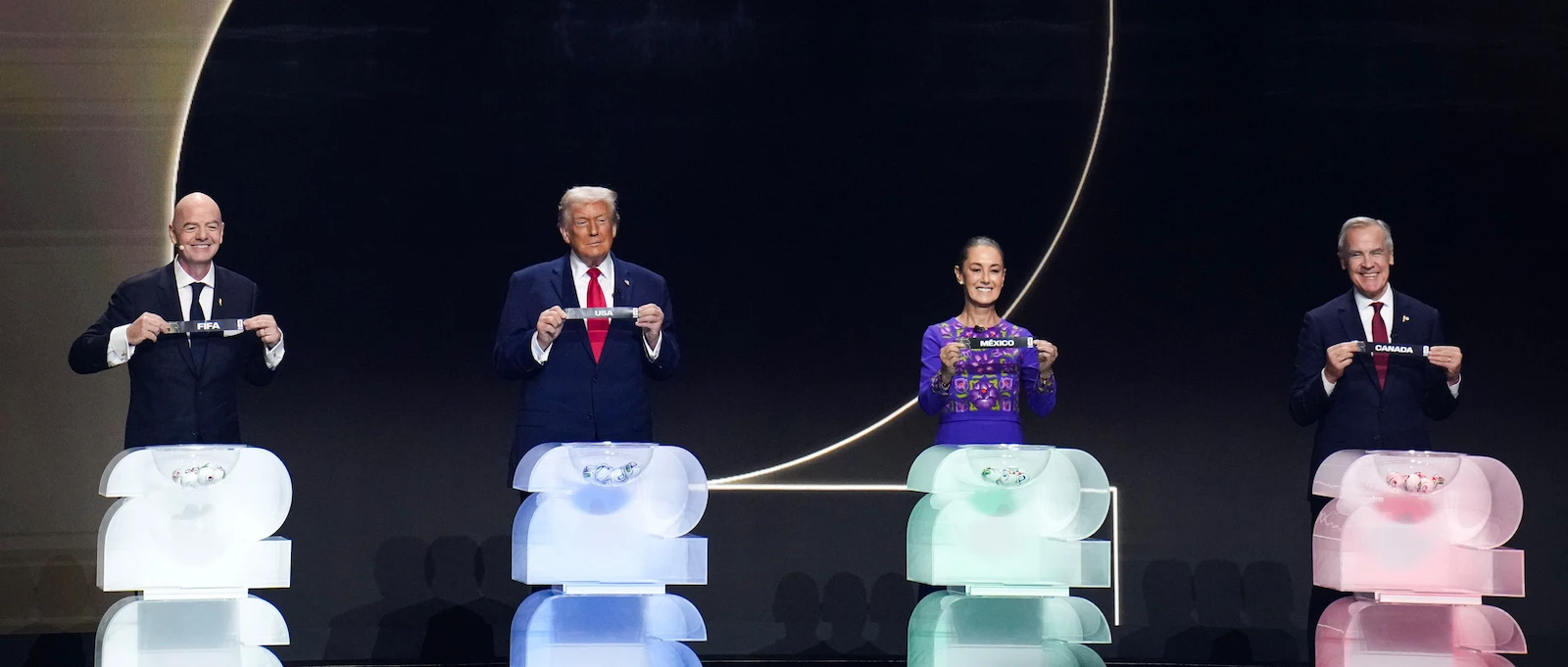
Image credit: U.S. Department of State / Freddie Everett (Public Domain)
We're getting 104 games at the 2026 World Cup. Forty more than the 64 we've been used to since France 1998. More football, more nations, more occasions. But it's worth asking the question before a ball is kicked: what will those extra games actually be worth?
The Biggest Tournament in History
As you're likely already aware, this is the biggest ever World Cup, featuring 48 nations — a sizeable increase from the 32-team format we've been used to for nearly three decades. Previous increases have been somewhat more modest. The tournament took the shape we recognise today, with groups and knockout rounds, at Switzerland 1954 where 16 nations competed. It remained a 16-team tournament until Spain 1982, when it jumped to 24 nations, before eventually expanding again to 32 teams for France 98.
The benefits are clear for all to see. More countries around the world get to enjoy watching their nation compete at a World Cup Finals. Smaller associations participate and hopefully reinvest the financial rewards into their football infrastructure. It also makes it more likely that multiple host nations will be required in future, giving countries that could never realistically self-host a World Cup a slice of the action. All of that is genuinely good for the global game.
But what about the quality on the pitch?
The Numbers Don't Lie
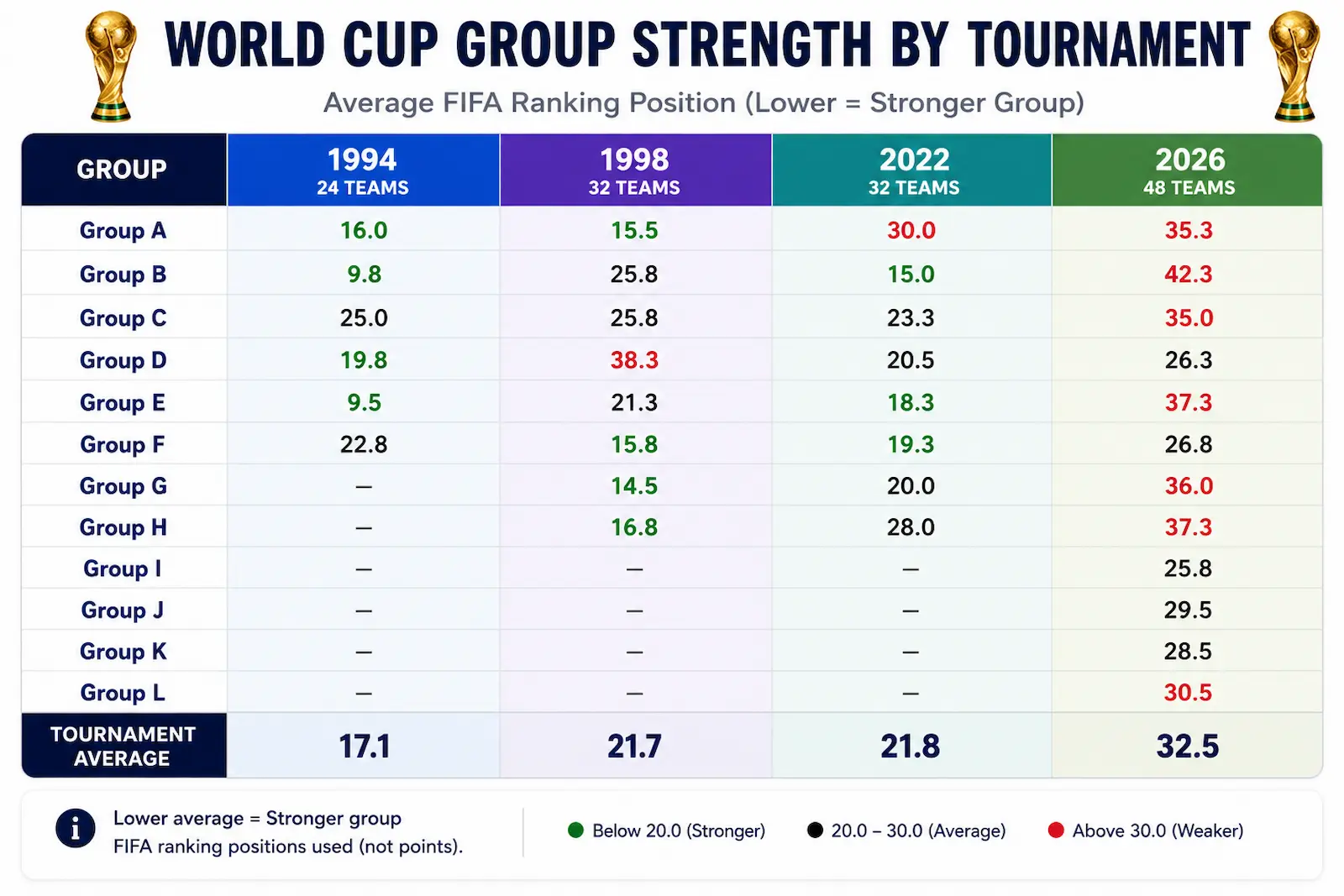
Image credit: MyTourneyTime
The jump from 32 to 48 teams is a 50% increase — the same scale as the leap from 16 to 24 back in 1982. The difference is that in 1982 there was enough quality to fill those extra spots. The question now is whether there is enough quality to meaningfully fill 16 more berths in 2026.
The data suggests not. FIFA rankings have been around since 1992 and were particularly volatile in the early years, so they are not a perfect science. What they do provide, particularly from 1998 onwards, is a reasonable barometer of how strong a group looks on paper going into a tournament. With that context in mind, the direction of travel is hard to ignore. The tournament average ranking position has risen from 21.8 at Qatar 2022 to 32.5 in 2026. The average group in 2026 is significantly weaker than any recent edition of the tournament.
Several groups have FIFA ranking mean averages above 35! Group B, the weakest in the tournament, averages 42.3, with its highest-ranked side sitting at 19th in the world. To put that in context, in a 32-team tournament that team would likely have been a group's second seed. Instead they are the standout nation in their group, with the remaining three sides ranked 30th, 55th and 65th in the world.
It is also worth noting that the strongest group in this 48-team format — Group D, averaging 26.3 — would have been the weakest group at the 1994 24-team tournament, and at best the third weakest of any group across the 1998 or 2022 editions.
More games, but with noticeably weaker opposition across large portions of the draw.
As an Amazon Associate, MyTourneyTime earns from qualifying purchases.
The Jeopardy Problem
And then there is the third-place rule. Eight of the twelve third-placed teams qualify for the Round of 32 — meaning that two-thirds of teams that finish third in a four-team group will go through. Combined with weaker groups, this feels like a step too far.
Consider Group I. France, Senegal, and an Erling Haaland-led Norway side. Under the old format, with only two teams qualifying, that group would have been must-watch television from the first whistle. If France dropped points against Senegal in their opening game you'd be looking at the genuine possibility of the tournament favourites going out at the group stage. Every subsequent match would have been enormous. That tension, the jeopardy, that's what makes group stage football worth watching.
With two-thirds of third-placed teams going through, that sense of danger is substantially reduced. A major nation can afford to lose a group game and still feel comfortable. The group stage risks becoming a prolonged warm-up act.
Managers Will Game the System
It goes further than just the atmosphere around results. Managers will adapt to the new structure, and not in ways that benefit the neutral fan. If a big nation wins their opening fixture convincingly, there is a very real argument for resting a number of key players for the remaining group games. Why risk your best players in a meaningless match against a minnow when you can keep them fresh for the knockout rounds, knowing your second-string side can comfortably do the job?
We could easily end up watching reserve elevens from the top nations playing out comfortable wins against weak opposition throughout the group stage, with the tournament only really starting to feel like a proper competition from the Round of 32 onwards.
The Uncomfortable Truth
Ultimately, as a fan, there is no real trust that decisions made by FIFA are made for the good of the game. More teams means more tickets, more broadcast slots, more commercial inventory, more revenue. The 40 extra games are not there because FIFA decided the world needed more competitive football. They are there because they could sell them.
The 2026 World Cup will still produce moments. It will still produce upsets, stories, and reasons to watch. But the group stage, which has historically been one of the most compelling and unpredictable phases of any tournament, risks being its least interesting iteration yet.
104 games. Let's hope they find a way to matter.
Try The Tools
Map the Full 2026 Tournament ⚽
Explore MyTourneyTime's World Cup tools, routes, fixtures and tournament views in one place.
Read Next
World Cup 2026 Group Stage Explained: Tiebreakers and Third-Place Qualification
For the first time ever, 48 teams will compete at a World Cup. Here's how group places are decided when teams are level on points & how the eight best third-placed sides earn their spot in the Round of 32.