Mexico City Awaits: Why England's Toughest Opponent Might Not Be Mexico
England face Mexico at the Azteca in the last 16. The climate, the altitude and 50 years of football folklore all favour the hosts.

Image credit: ProtoplasmaKid · CC BY 4.0
England versus Mexico in the last 16. It's a fixture MyTourneyTime have had circled for a while. England winning Group L as expected, Mexico doing the same on home soil — the draw always carried the logic that these two would meet here. We noted early in the tournament that this route, via Mexico City and then Miami for the winner, represented by far the most climatically punishing path in the entire draw. Our World Cup 2026 Climate Routes article rated both venues as the tournament's most difficult playing environments, and that context is essential to understanding what England are walking into.
The Allure of the Azteca
Before the science and the statistics, it's worth pausing on where this match is actually being played. The Estadio Azteca is, by any measure, football's most storied venue. It has now hosted 24 World Cup matches across three tournaments — a record — with this round of 16 tie its final fixture of 2026.
Its place in folklore is anchored to moments that transcend the sport. Plaques on the outside of the stadium commemorate two of the most celebrated events in football history: "The Game of the Century" (Italy 4-3 West Germany in the 1970 semi-final) and "The Goal of the Century" (Maradona's mesmeric solo run against England in 1986). The stadium was also the setting for another of footballs most iconic goals. Carlos Alberto, who applied the perfect finish to arguably the greatest team goal ever scored when he blasted home in Brazil's 4-1 win over Italy in the 1970 final, recalled the occasion with reverence. "The atmosphere, the noise in that Final was unbelievable. You felt like the whole of Mexico was Brazilian. Wonderful, indescribable." Pelé put it simply: "There's just something very special about the Azteca. You need to be inside it, to feel it to understand. It's unique." Mexico's preeminent football historian Juan Villoro goes further, describing it as the "Cathedral of football."
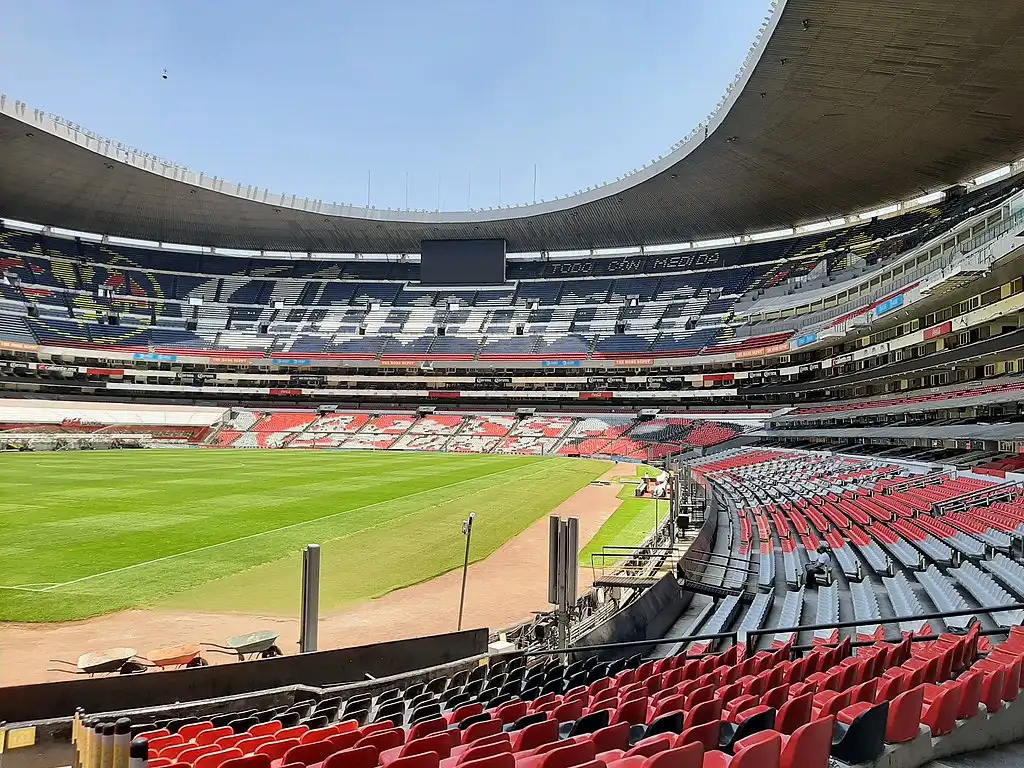
Image credit: Luicheto · CC BY-SA 4.0 · Converted to WebP, resized to 1024px

As an Amazon Associate, MyTourneyTime earns from qualifying purchases.
The Menace of Mexico City
The romance of the Azteca is real. So is the brutal reality of playing there.
The stadium sits at roughly 2,240 metres above sea level. Mexico have lost just twice in 89 competitive matches at the ground. Coming into this fixture, they are unbeaten across 10 World Cup matches played there across three tournaments. At this World Cup alone: four matches, four wins, eight goals scored, none conceded. Three of those matches were at the Azteca.
England manager Thomas Tuchel has already been candid about what awaits. "My understanding is that we cannot adapt to the altitude. That is just a huge advantage that Mexico will have. It just takes too much time."
He is not wrong, and he is not the first England figure to say it. Gary Lineker, who played at the Azteca in 1986, was direct: "I've played at altitude — it's tough." Peter Reid, also part of that squad, was blunter still: "You never really acclimatise."
England have history with this particular problem. Ahead of the 1970 World Cup, the FA took altitude so seriously that they appointed England's first full-time team doctor, Neil Phillips, specifically to address the effects. Physiologist Griffith Pugh was brought in and the squad spent three weeks acclimatising in Mexico City. Team-mate Alan Mullery recalled that even Bobby Moore "looked like death warmed up and had almost lost a stone" on arrival. The notable thing is that altitude affects people differently. After Czechia's defeat by Mexico in Mexico City at this tournament, coach Miroslav Koubek confirmed midfielder Denis Višinský "was heavily affected by the high altitude." Even within a squad, you cannot be certain who will cope and who will not.
American pundit and former USMNT player Eric Wynalda was characteristically unfiltered: "The Azteca is the worst place to ever play a sporting event. It will make you spin anyway because you can't breathe."
The science backs all of this up. German team doctor Tim Meyer, one of the more respected sports medicine voices in international football, put it plainly: "I think the advantage for Mexico is quite huge." At altitude, he explained, "your heart beats faster and your breathing becomes faster and deeper", with a rise of "20 or 30 beats" per minute after arrival that "can be incompatible with sleep."
The academic literature is equally unambiguous. The FIFA-era consensus statement by Bärtsch, Saltin and Dvorak — still the key practical guidance document — recommends roughly one to two weeks of acclimatisation for altitudes in the 2,000 to 3,000 metre range. Mexico City sits squarely in that bracket, meaning same-week adaptation is considered poor practice. Analysis of the 2010 World Cup by George Nassis found that matches played above 1,200 metres showed 3.1% lower total distance covered compared to sea level. The Azteca is almost double that altitude.
The home advantage data is the most striking of all. A BMJ study found that each additional 1,000 metres of altitude difference increased goal difference by approximately half a goal in favour of the home side. A later European study found that every 100 metres of altitude difference was associated with a 1.1% point increase in the home team's win probability. A 2026 World Cup-specific sports medicine review applied that logic directly to this tournament, confirming the same approximate half-goal advantage per 1,000 metres.

Image credit: Unknown author · Dutch National Archives (ANEFO) · CC0 1.0
One caveat worth noting: the thin air is not entirely negative for athletic performance. The 1968 Mexico City Olympics produced world records in every short sprint, the long jump and triple jump. Bob Beamon's iconic 8.90 metre long jump was the defining image of those Games and stood as a world record for almost 23 years. The thinner air means the ball travels faster and explosive efforts benefit. The problem is that recovery from those efforts is significantly harder. You can sprint; you just cannot repeat it as often. Tuchels effective use of substitutes will be crucial.
Due to their group stage being played in the United States, England are expected to employ the fly-in, fly-out approach, arriving as close to kick-off as possible to minimise time at altitude. It is a legitimate strategy supported by the broader sports science literature as an alternative to full acclimatisation. But it is a workaround, not a solution.
The Verdict
Home advantage with a passionate Mexican crowd behind you would be a significant factor at sea level. Add in the half-goal altitude benefit for every 1,000 metres and Mexico are effectively a goal up before a boot has been tied.
What is harder to calibrate is how good this Mexico side actually are. Played four, won four, scored eight, conceded none is an imperious tournament so far — but they are yet to face a team of England's quality. They lack players with global name recognition, with the base of the starting 11 plying their trade in Liga MX. But that is also precisely what has given them their advantage here. The players based abroad have been home for over a month and will be fully acclimatised. England's star-studded squad will need to deliver in the most hostile environment in world football.
Englands fly-in, fly-out plan needs to read MEX > MIA. Not MEX > LHR.
Try The Tools
Can you get all the way to the final in our world cup quiz?
Explore MyTourneyTime's World Cup tools, routes, fixtures and tournament views in one place.
Read Next
Feature: Climate Knockout Crisis World Cup ’26
Major advantages lie ahead for those on the right route. Use our climate chart to see which teams benefit.